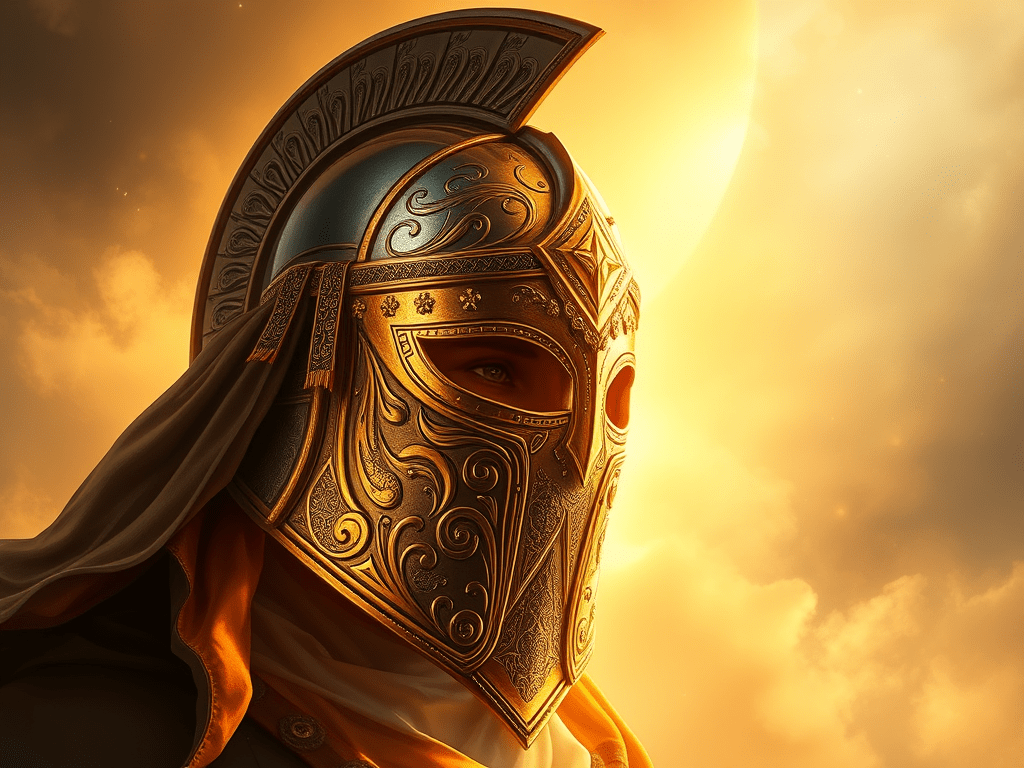
And take the helmet of salvation… – Ephesians 6:17
(Watch the corresponding sermon here: https://www.youtube.com/live/MENjcginFrA?si=d-n8Lru4A2O3CAUF)
In the book of Ephesians, Paul likens salvation to a helmet, or more specifically, the hope of salvation. In First Thessalonians, he repeats the metaphor:
… putting on the breastplate of faith and love, and as a helmet the hope of salvation. – 1 Thessalonians 5:8
Why is the hope of salvation a helmet? What does Paul mean by this?
What is Salvation?
First, we must understand what is meant by ‘salvation,’ or, ‘the hope of salvation.’ ‘Salvation’ is simply a noun form of the word ‘save.’ A person who has salvation is a person who is saved. For example, if a person is facing financial ruin and happens to find a rare and expensive artifact when rummaging through his late father’s belongings, he might lift it into the air and say, “This is my salvation!” What he means is that the object, when sold, will fetch such a price that will save him from financial ruin.
In a Christian context, when we speak of salvation, we also refer to being saved from some ruin. That ruin is multifaceted, for the Christian is saved from much ruin. First, we are saved from the bondage and misery of our sins. Second, we are saved from the darkness and hopelessness of this world, being carried through our time here in the arms of Jesus, overcoming the world, the flesh, and the devil. Finally, we are saved from death and hell. One day, Christ will quite literally save us from physical death, whether by transforming our bodies at His coming or by raising us physically from the grave. This is what is meant by salvation, which I will sum up here:
Salvation – saved from:
- Sin
- The world
- Death
Some have put it this way: We have been saved (from sin and its misery), are being saved (from the world, the flesh, and the devil), and will be saved (from death and hell).
When Paul tells us to put on salvation as a helmet, which aspect of our salvation is he speaking of? By referencing 1 Thessalonians 5:8, it seems reasonable to assume that he is speaking of our future and ultimate salvation, as he puts it, our hope of salvation.
Salvation as a Helmet
Why is salvation likened to a helmet? Paul doesn’t tell us exactly why he likens salvation to a helmet, so we cannot know for sure what is in his mind. We can be fairly sure that, as a learned man of scripture, he was drawing from the Old Testament for his analogy. In Isaiah 58:17, the scripture says this:
For He (God) put on righteousness as a breastplate, and a helmet of salvation on His head… – Isaiah 59:17
God is not ascribed as wearing a helmet of salvation because He needs salvation. But that He also has hope of ultimate salvation. Not a salvation He will receive, but one He will give. Part of our warfare, therefore, is a hope of better things to come. I do not mean ‘hope’ in the worldly sense, for the word is often used in our language to portray the exact opposite of what it really means. The true meaning of the word is a strong confidence in things to come, not a doubtful one. Therefore, the helmet that we wear, which gives us confidence in our fight, is a strong hope in the fullness of our salvation which is to come.
Helmets give confidence. A good helmet can cause blows that would normally kill a man to ricochet off.
I remember when I was younger my mother took us to the mountains to ski and snowboard. We were presented with the option to rent a helmet with our snowboard, and we did so. I was amazed at how much safer I felt with that helmet on! I was confident that I could try a trick or two and not bash my skull against the ground. In the same way, we can go into our battles with Satan with confidence. But no matter what he throws at us, no matter what persecution or difficult circumstance he may bring, we can be confident, because our hope is not in this life, but in the salvation to come.
This is why Christians have long put themselves in harm’s way in their efforts to spread the gospel of Christ to the world. Why would any person go to dangerous and hostile nations to preach the gospel if their hope was in this life only? Indeed, the greatest missionaries ‘did not love their lives to the death’ (Revelation 12:11). Their confidence came from their expectation of their ultimate salvation.
Many of us are familiar with the missionary work that was done in the jungles of Ecuador by a group of men seeking to reach the Waodani people, a savage tribe known for their violence. The men knew of the danger of this mission, yet they went anyway. Why were they willing and able to face the darkness and risk their lives? It was because they had the hope of salvation as a helmet. They knew their hope was not in this life, nor in what could be achieved in this life. They knew that death couldn’t prevent them from receiving their ultimate inheritance.
These brave missionaries were quickly killed by the Waodani, speared to death in the encampment set up to reach them. Their deaths were widely reported in America with Life Magazine writing a ten-page article. The title was this: “Go ye and preach the gospel: five do and die.” Doubtless, many shook their heads when reading this article, thinking how foolish it was (in their mind) for these men to waste their lives in such a way. But Jim Elliot, one of the deceased missionaries, had said something very profound:
“He is no fool who gives what he cannot keep to gain that which he cannot lose.”-Jim Elliot
What we cannot keep is our lives in this world. If we give unto Christ and His work our earthly lives, we will ultimately receive that inheritance that will last forever.
In this way, the hope of our salvation is a helmet. We should not fear death or suffering or loss in this life. For us, to live is Christ and to die is gain. If we live, we live to labor for the kingdom of God. If we die, we rest until the day of resurrection.
For to me, to live is Christ, and to die is gain… – Philippians 1:21
Our Helmet Must Be Put On
I don’t believe most Christians in our day have the hope of salvation as a helmet on their head. Instead, they wear the hope of a better life now as a helmet on their head. They are concerned much more about the things of this life. They live as if the more important life is now and that the life to come is just an end cap of their existence.
The helmet is over the head, protecting the mind. This tells me that the hope of salvation should be ever prevalent in our minds. We should ask ourselves how much we meditate on the life to come as opposed to the life that is now. I am afraid that most of us would have to admit that our minds are not on heavenly things as they should be but on the things of this earth (Colossians 3:1-2). Most of us do not think about laying up treasures for ourselves in heaven, but for seeking treasure on earth. This makes no sense for one who believes in Christ and God. Why would we work for what will pass away rather than what is eternal? We certainly must provide for our own; I am not saying that we should abandon this world and live in the desert or a monastery. The primary change needs to be in our minds, regardless of what we do. This means different things for different people, but we all should have one goal: to please the Father and populate the kingdom. Jesus said to us, “Do business until I come” (Luke 19:13). It is not worldly business that he speaks of, but his ‘father’s business’ (Luke 2:49).
Will You Do It?
Will you put on the hope of salvation as a helmet? Will you scorn thoughts of worldly success in favor of heavenly rewards? If you love your life in this world, how can you charge into a battle where you could lose your reputation, your wealth, your family, or even your life?
I propose that we all begin to change the way we daydream. We all have a picture in our minds of where we want to be in this world. We can see the kind of house we’d like to have, the kind of car we’d like to drive, etc. We can see our ideal spouse and children. We can see our dream job, etc. Most people do this. But this is not how God wants us to think, especially when these kinds of thoughts hold the predominant place in our minds. If our thoughts are on these things, how can we obey the command to set our minds on things above? Instead, we should learn to daydream about the kingdom of God coming. We should daydream about Jesus coming and the new kingdom that will reign on the earth.
We have heard the saying, “He is too heavenly-minded to be any earthly good.” But I couldn’t disagree more. If a person is truly heavenly-minded, he will do the most good. This is largely the difference between a Christian and a worldly person. Their minds are on the world, what they can heap up before they die, but our minds are on the next world, what we can lay up for that time.
We see that the great men and women of the Bible thought this way and, as a result, did much good in this world. Paul wrote that our ‘citizenship is in heaven,’ and that we ‘eagerly wait for the Savior’ (Philippians 3:20). In the same book, he wrote that he considers all worldly things rubbish that he may know Christ and attain unto the resurrection (Philippians 3:7-11). Further, he said he had one goal: to forget the past and press on for the prize (Philippians 3:13-14). This does not sound like a man thinking about his dream home. It sounds like a man occupied with the kingdom of heaven. Every author of the New Testament reflects the same sentiment.
I love what C.S. Lewis wrote about this subject in his book, Mere Christianity. He said this:
If you read history you will find that the Christians who did most for the present world were just those who thought most of the next. The Apostles themselves, who set on foot the conversion of the Roman Empire, the great men who built up the Middle Ages, the English Evangelicals who abolished the Slave Trade, all left their mark on Earth, precisely because their minds were occupied with Heaven. It is since Christians have largely ceased to think of the other world that they have become so ineffective in this. Aim at Heaven and you will get earth “thrown in”: aim at earth and you will get neither. – C. S. Lewis. Mere Christianity – Chapter 10
Conclusion
The salvation that we look for must be put on as a helmet. We must wear it as a soldier wears it to battle. This salvation should be constantly on our minds. As with all our equipment, it is essential to be effective in battle, giving us confidence in the fight. With our minds on heaven, we can dash into the dangers of this world without fear of loss. Satan cannot harm the one whose hope is not in this world. He cannot touch treasures that are laid up in heaven.
 Hal Chaffee Ministries